




The capacity to think clearly has never been more crucial in a world full of fast information, conflicting viewpoints, digital distractions, and quick reflexes. Just as physical exercise strengthens your body, critical thinking exercises help you train your brain. They improve logic, judgment, creativity, problem-solving skills, and the capacity to comprehend circumstances from several perspectives.
This tutorial explains all you need to know, including what critical thinking actually is, why it’s important, and the best exercises you can do right now to sharpen your critical thinking abilities.
What Does Critical Thinking Mean?
The capacity to analyze data, challenge presumptions, assess evidence, solve issues rationally, and reach well-reasoned conclusions is known as critical thinking. It is more than just learning things by heart. Rather, it emphasizes how you think rather than what you think.
Strong critical thinking abilities enable one to: Identify biases
- Analyze arguments
- Deconstruct difficult issues
- Make better inquiries
- Make judgments based on reason rather than feelings.
And much like every other skill, critical thinking improves with practice—through focused activities.
The Significance of Critical Thinking Exercises
1. They Enhance Daily Decision-Making
Every day, we make hundreds of decisions, many of which we are unaware of. You can pause, weigh your options, and firmly and logically select the best course of action with the aid of critical thinking.
2. They Assist You in Discovering Truth in the Digital Age
It’s simple to become confused with AI, social media, clickbait, and false information. You can distinguish between facts and views, truth and falsity, and logic and manipulating by engaging in critical thinking tasks.
3. They Improve Problem-Solving Capabilities
Strong critical thinking enables you to approach issues from new perspectives, whether you’re dealing with obstacles at work, in your studies, or in your personal life.
4. They Increase Originality
Unexpectedly, creativity and critical thinking go side in together. You can discover novel concepts and unorthodox solutions when you are able to dismantle presumptions.
5. They Build Confidence
The ability to reason clearly and defend your decisions makes you more confident personally and professionally.
The Best Critical Thinking Activities
The top mental exercises are listed below. Teachers, psychologists, and high-achieving professions employ these tried-and-true methods.
1. The Exercise “Five Whys”
This traditional approach aids in identifying the true source of an issue.
How it operates
Ask “Why?” repeatedly until you identify the underlying cause of a situation, which is often accomplished in five rounds.
For instance:
Problem: I’m constantly exhausted after studying late.
- I start studying late, so that’s why.
- Why? Because I squander time using my phone.
- Why? Because I don’t feel inspired at first.
- I don’t have a study plan, which is why.
- I don’t have specific ambitions, which is why.
Finally: Lack of preparation is the true issue, not the phone.
2. The “Devil’s Advocate” Method
Put your own opinions to the test by making arguments against them.
Why it functions
It makes you recognize the shortcomings in your opinions, lessens emotional prejudice, and improves your logic.
Methods for practicing:
Choose a viewpoint or conclusion and attempt to refute it. Ask yourself, “What evidence contradicts this?” if you’re having trouble.
How could someone else refute me?
3. Analysis of Scenarios
Construct hypothetical scenarios and investigate potential solutions.
- For instance, “What would I do if my company suddenly lost its top customer?”
- “If I had just one day to finish a three-day project, how would I react?”
Quick thinking and future planning are enhanced when possibilities are considered.
4. The Task of “What If?”
ideal for fostering strategic thinking and innovation.
For instance:
- What would happen if social media vanished tomorrow?
- What would happen if you only had half the resources available to you?
- What would happen if your largest rival stole your concept?
This practice increases your mental adaptability and promotes problem-solving.
5. Mental mapping
A visual way to arrange ideas, solutions, and thoughts.
How to do it:
- Put your primary subject in the middle.
- Draw branches that link related concepts.
- Include more in-depth subtopics.
This enhances memory, lucidity, and the production of ideas.
6. Deductive Reasoning Conundrums
Deductive reasoning facilitates the transition from broad assertions to precise conclusions.
An example of an exercise
- First premise: Every professional athlete works out every day.
- Second premise: Liam competes professionally in sports.
- In conclusion: Liam works out every day.
Putting these into practice improves your reasoning skills.
7. Red-Team Thoughts
This tactic, which is employed by businesses and the military, entails creating a group—or imagining one—whose task it is to oppose your strategy.
- Advantages
- eliminates blind spots
- lessens arrogance
- enhances strategic planning
Imagining a “red team” challenging every action, even when you’re by yourself, can help you think more clearly.
8. Interpreting Between the Lines
Consider a debate or news story and ask yourself, “What is the author not saying?”
- What presumptions does this paragraph make?
- What proof is lacking?
You learn to recognize slight bias and concealed meaning from this.
9. The Task of Reverse Thought
Rather than inquiring, “How do I fix this?” “How could I make this problem worse?” is the opposite question to ask.
- Strangely, this offers answers you may not have thought about.
- For instance, you wish to enhance customer service.
“How can we make customer service terrible?” is the reverse question.
Some possible responses are:
- Prolonged wait times
- No responses to messages
- Unpleasant employees
If you flip these responses, you will see benefits right away.
10. Examine and Differ
Compare two concepts, goods, or points of view:
- Advantages
- Weaknesses
- Presumptions
- Proof
This fosters clarity and organized thought.
11. Searching for Evidence
When you have a strong belief, consider this:
- Where is the evidence?
- How trustworthy is the source?
- Is this a fact or a viewpoint?
To improve analytical thinking, this activity is crucial.
12. The Socratic Approach to Questioning
This develops complex reasoning and bears Socrates’ name.
- Pose queries such as “What do I mean by this?”
- How can I be certain that this is accurate?
- What is an illustration?
- What other explanation is there?
It aids in clearing up misunderstanding and improving reasoning.
Critical Thinking Exercises
Regular Practice of Critical Thinking Every Day
This is a simple routine that you can adhere to:
Morning (five minutes)
To get your mind going, ask one “What If?” question.
10 minutes in the afternoon
Use the Five Whys to solve a real-world issue.
Evening (10 minutes)
After reading a piece of writing or seeing a video, note:
- Presumptions
- Prejudices
- Absence of evidence
Every week for 20 to 30 minutes
Make a complete mind map or scenario analysis for a decision you’re making at work or for yourself.
Examples of Practical Critical Thinking Exercises
1. Situations at Work
Businesses employ activities such as:
- Case studies
- Simulations of strategies
- Discussions in groups
- Root-cause investigation
These assist staff members in developing their leadership and problem-solving skills.
2. Academic Education
Students enhance their analysis through:
- Assessing various hypotheses
- Finding weaknesses in arguments
- Resolving logical riddles
- Discussing subjects in class
3. Individual Life
When do you apply critical thinking?
- Selecting between employment offers
- Handling disputes
- Making financial plans
- Making choices about one’s health
Exercises teach your mind to look past feelings and make better decisions.
Advantages of Frequent Critical Thinking Exercises
1. Improved Evaluation
You become more conscious of your choices and thoughts.
2. Better Interaction
You are able to respectfully and clearly voice your opinions.
3. Increased Originality
It comes easy to you to think creatively.
4. Better Emotional Regulation
Critical thinkers think things out rather than responding right away.
5. Improved Academic and Professional Performance
Analytical thinkers are more valued than ever by employers and academic institutions.
Critical Thinking Exercises
Typical Errors That Prevent Critical Thinking
1. Taking information at face value
Always check and ask questions.
2. Allowing feelings to rule
Though balanced logic is crucial, feelings do important.
3. Disregarding information that challenges your views
We refer to this as confirmation bias.
4. Relying on conjecture rather than facts
You may be misled by assumptions.
5. Steering clear of challenging queries
Challenging yourself leads to growth.
How to Make Critical Thinking a Part of Your Everyday Life
- Read more information that is scientific or critical.
- Talk to others who hold diverse opinions.
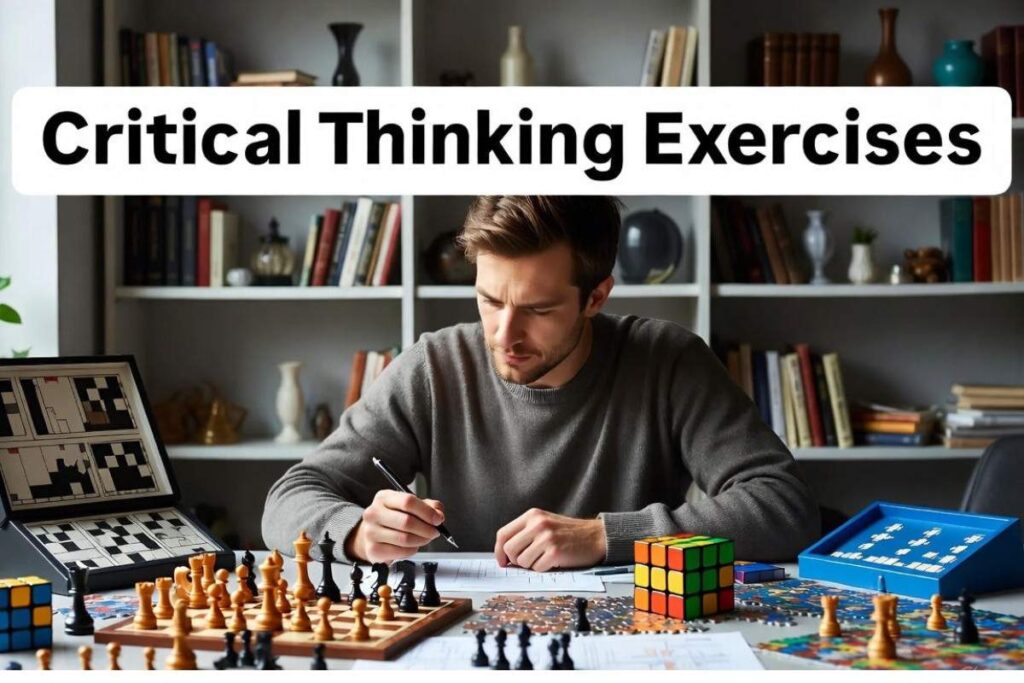
- Engage in brain-training activities such as logic puzzles or chess.
- In everyday life, ask more in-depth questions.
- Take your time making decisions.
- To monitor your reasoning, keep a “thinking journal.”
Conclusion: Your Best Tool For Critical Thinking Exercises
Critical thinking is a lifetime advantage rather than only a skill. Regularly engaging in critical thinking exercises can change your perspective on the world, regardless of your role—student, professional, business owner, or just someone looking to make better decisions.
The Five Whys, Socratic inquiry, scenario analysis, reverse thinking, and other mental exercises in this program help you become more creative, logical, and self-assured.
Start small, maintain consistency, and you’ll see daily improvements in your ability to think.