




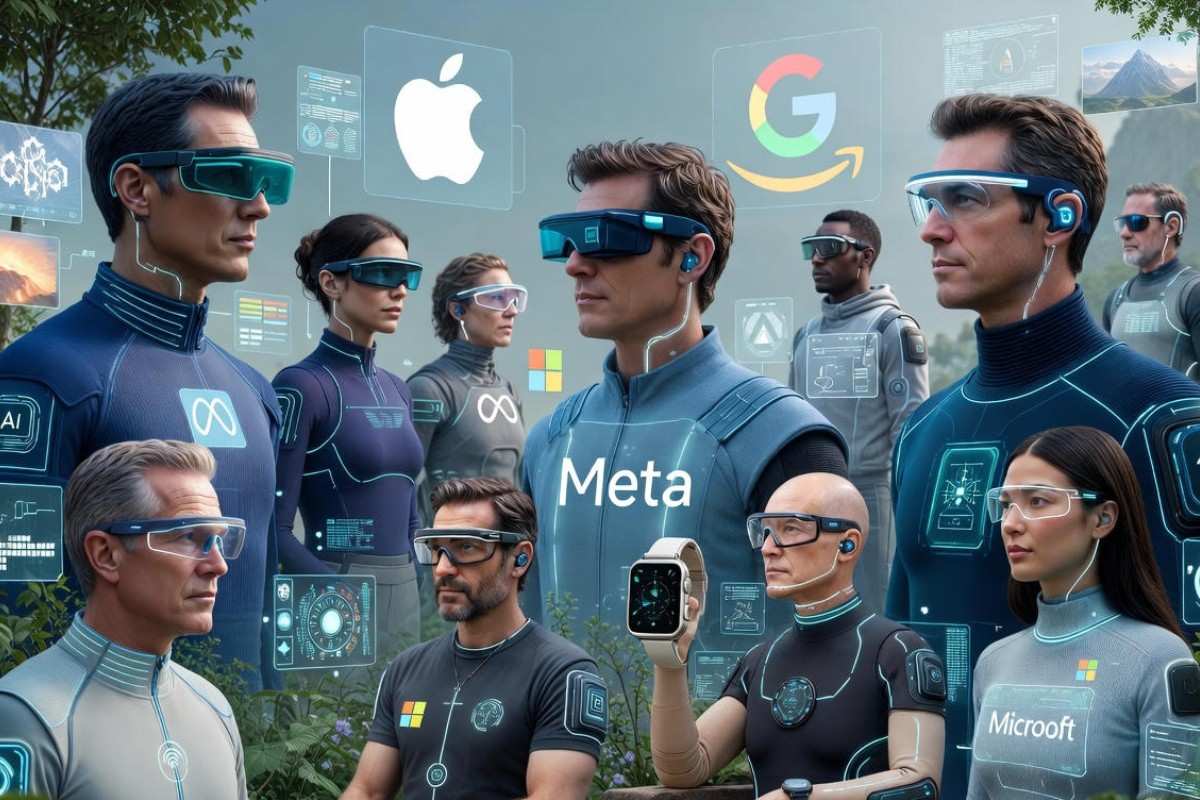
The smartphone has dominated our digital world for almost 20 years. In addition to replacing cameras, maps, calculators, calendars, and computers, it also changed the way humans connect with the outside world. However, a single thing has become very evident in 2025: tech companies see a world beyond smartphones, and this change is occurring more quickly than most people anticipated.
The largest tech firms, including Apple, Google, Meta, Amazon, Samsung, and Microsoft, are getting ready for a time when smartphone screens won’t be our main knowledge source. Rather, they are creating platforms, ecosystems, and gadgets that mix in perfectly with our environment, our senses, and ultimately our bodies.
This is a reinvention of human-technology interaction rather than merely innovation.
The Smartphone Plateau: The Reasons Behind Big Tech’s Transition
The smartphone market is still growing, but it no longer surprises us. Improvements like improved cameras, a little longer battery life, and a few AI functions are now commonplace.
However, digital titans thrive on disruption and aren’t designed for stagnation. Companies are focusing on more than just phones for three main reasons:
1. The pace of hardware innovation has slowed.
Designs for phones have reached a creative dead end. Faster chips, folding screens, and edge-to-edge displays are fascinating, but they no longer transform life in the same way that early cellphones did.
2. The Rise of Wearables and Ambient Gadgets
Smartphone technology is gradually being eclipsed by smartwatches, augmented reality (AR) glasses, smart speakers, and health trackers. People are looking for technology that can be used without being grasped.
3. New Connections Are Needed for AI and Spatial Computing
Real-time assistants, holograms, AI-generated prompts, and spatial settings all benefit from immersive gear rather than flat screens.
Tech corporations are already designing something far larger after realizing these constraints.
The World Built on Spatial Computing: Apple’s Vision
With the iPhone, Apple may still rule the smart phone market, but its true future is in Vision Pro, wearable health technology, inexpensive AR glasses, and clever ambient computing.
The Spark Vision Pro
With the introduction of spatial computing with Apple’s Vision Pro, programs may now float in three dimensions, fusing the virtual and the physical. It is the beginning of a new platform that Apple hopes will eventually outperform the iPhone.
Apple has a history of rapid iteration, despite the size and cost of early versions:
- 3G was absent from the original iPhone.
- The original Apple Watch was constrained and slow.
- Both are now leaders in their respective fields.
There are also rumors that Apple is developing AR glasses for daily use, which might eliminate the need to always monitor a phone screen.
Apple’s biggest risk is health
AirPods and the Apple Watch are becoming commonplace, quiet companions. In the future:
- Blood glucose monitoring
- Monitoring stress levels
- Prediction of sleep disorders
- Instantaneous health coaching
Will everything take place on its own, without the need for a phone screen?
For Apple, the future is not a pocket-sized gadget but rather a digital overlay over the actual world.
Google’s Strategy: AI Helpers Everywhere, No Need for Screens
Google has always envisioned subliminal technologies, such as ambient systems, eyewear, and intelligent assistants.
AI Agents Take the Place of Conventional Apps
Through Gemini powering its upcoming devices, Google wants consumers to be able to look at a certain thing, speak, or gesture and get immediate assistance.
- Imagine: Using your finger to obtain data regarding an object
- Using tiny augmented reality glasses to navigate
- Requesting that an AI bot organize your whole day
Using this type of ambient intelligence eliminates the need to swipe and tap among apps.
AR Glasses’ Comeback
Although Google Glass failed in 2013, the concept wasn’t flawed; it was just too early. Google is now making significant investments in lightweight AR devices due to improved processing, AI, and downsizing.
These upcoming eyewear could:
- Show text in your area of vision.
- Instantaneous speech translation
- lead you step-by-step through challenging challenges
Instead of being the focal point, the smartphone screen becomes just one choice.
Meta’s Future: Screen-Free Social Environments
The biggest wager on VR, AR, avatars, and virtual worlds is being built by Meta. The holographic internet is the next computer platform, according to their straightforward vision.
Meta Quest, and AR Eyewear
- In the world that Mark Zuckerberg envisions,
- Realistic avatars are used in work meetings.
- Fitness applications monitor your movement in three dimensions.
- Social events are held in immersive environments.
By providing camera, audio, and AI features in a stylish frame, Meta’s AR glasses—which were created in collaboration with Ray-Ban—are already closing that gap.
Hands-Free Communication
Meta wants consumers to have control over technology by:
- Neural wristbands
- Eye tracking
- Voice directives
This implies that your next “phone” might not be something you hold, but rather something you wear.
Amazon’s Route: Hidden Technology and Intelligent Homes
Amazon is developing ambient intelligence in homes and workplaces rather than phones.
Using Alexa as the Main Interface
According to Amazon, the future gadget will be a system rather than a gadget.
Eventually, Alexa will:
- Recognize feelings
- Estimate needs
- Control the systems in your home
- act as each family member’s own AI helper
Amazon views the smartphone as just one control in a bigger set as smart homes become increasingly widespread.
Wearable Technology and Micro Devices
Amazon wants technology to be so seamless that you hardly see it, from Ring devices to Echo Frames.
The intention is to make technology invisible.
Microsoft and Samsung: Establishing the Post-Phone Computing Architecture
Samsung’s Foldable and Flexible Hardware Future
Samsung is at the forefront of hardware form factor innovation:
- Rollable screens
- Wrist-wrapping exhibits
- Intelligent rings
- Wearable AR
Based on Samsung, screens would not adhere to a strict rectangle but will instead change shape in response to demands.
The Spatial and Enterprise Vision of Microsoft
Microsoft prioritizes:
- The HoloLens
- Business AR
- Tools for productivity for mixed reality
- Copilots with AI
Smartphones are helpful, but integrated workspaces and intelligent efficiency are the way of the future, according to Microsoft.
AI Assistants’ Ascent: Your “Phone” Develops a Personality
Hardware is not the largest change; rather, AI is taking over as the main interface.
Already, AI agents
- Recognize the context
- Complete tasks
- Make schedules
- Compose messages
- Condense the information.
Your AI will soon:
- Recognize your preferences
- Be mindful of your requirements
- Take action on your behalf
- Work in a variety of settings and platforms
Whenever the AI resides in a smartwatch, headphones, or glasses won’t matter; the smartphone will become less important.
Tech Giants Envision Future Beyond Smartphones
What Will Happen in the Post-Smartphone Ecosystem?
One gadget won’t rule the globe after smartphones. It will be a network of linked technologies instead.
1. AR eyewear
Always-on, fashionable, lightweight screens that eliminate the need to check your cell phone.
2. Wearable AI Technology
bracelets, badges, and smart rings that monitor biometrics and offer data.
3. Intelligent Earphones
Via small earbuds, your AI friend will guide you through everyday life.
4. Intelligent Houses as Add-ons
Your house will become a part of your digital brain, reacting to your daily activities.
5. Operating Systems in Space
Apps will move about you, adjust to your surroundings, and react to your movements.
After a while, you won’t have to question, “Where’s my phone?” since it will be everywhere.
How This Future Affects Everyday Life
Interaction
You see messages in your field of view. Voice takes precedence.
Navigating
Your journey is guided in real time by AR arrows without the need for a phone.
Work
Monitors are replaced by holographic screens. Your duties are instantly organized by AI.
Learning
Instructions, translations, and illustrations are displayed in real time by AR overlays.
Health
Wearables identify problems before they manifest as symptoms.
Amusement
Essentially a personal media cloud, movies, games, and music travel with you.
Life becomes more immersive, hands-free, and flexible.
Will Smartphones Eventually Go Away?
Not anytime soon. However, they will play a much smaller part.
Similarly:
- After cellphones, PCs did not vanish.
- After tablets, TVs did not go away.
- After mobile phones, landlines did not vanish.
The mobile phone will continue to exist, but it will be a component of a bigger system rather than its central component.
The phone will go from being a primary device to a backup device during the course of the next ten years.
Distributed technology—tech that surrounds us rather than resides in our pockets—will eventually take over the globe.
Conclusion: The Next Revolutionary in Computing Has Started
The shift toward a world beyond smartphones is already happening, according to IT heavyweights. Artificial intelligence (AI) assistants, wearable technology, smart homes, augmented reality glasses, and spatial computing are all examples of how technology is becoming more seamless, natural, and incorporated into daily life.
The decade of smartphones ruled the 2010s and 2020s.
However, the 2030s will belong to:
- The AI
- Computing in space
- AR and VR
- Ecosystems for wearables
- Intelligent surroundings
The question now is not if we will outgrow cellphones, but rather how soon.
Furthermore, the future appears to be very promising.
✅ FAQs For The Tech Giants Envision Future Beyond Smartphones
1. Why are the biggest IT companies going beyond smartphones?
AI, AR, and wearable technologies provide more immersive and natural engagement, but hardware progress has stagnated.
2. What gadgets could take the place of smartphones?
Wearable AI assistants, AR glasses, smart earphones, and spatial computing gadgets may become the main digital tools.
3. Will smartphones go away entirely?
Not anytime soon. Over time, they will become a backup or secondary device instead of the primary one.
4. How will user engagement be altered by AI assistants?
AI will eliminate the need for a physical screen by completing activities, making decisions, making recommendations, and operating across devices.
5. Which businesses are setting the standard for the post-smartphone era?
The next generation of smart and immersive technologies is being developed by Apple, Google, Meta, Samsung, Microsoft, and Amazon.